Case study
ad ops platform.
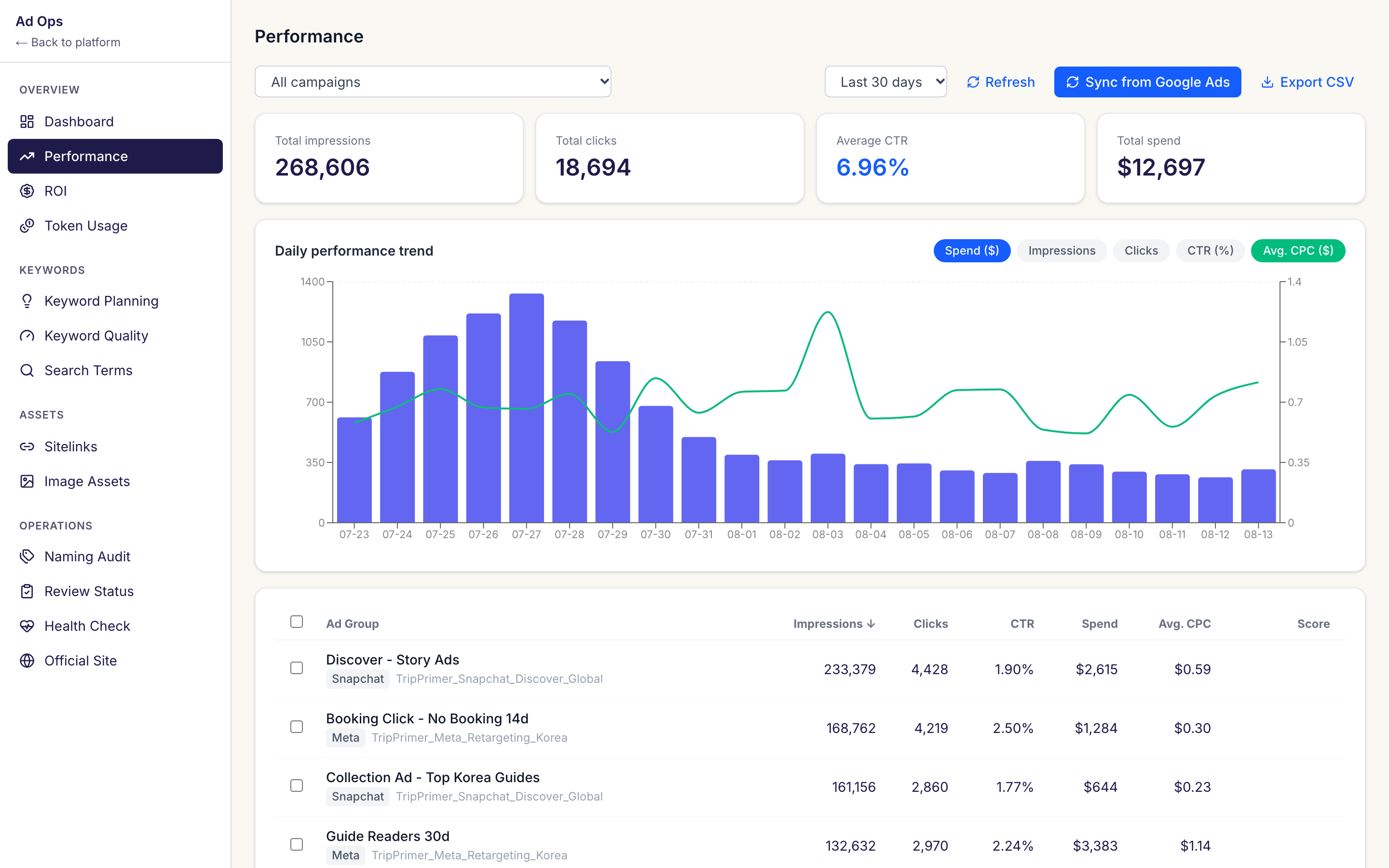
Gives a paid-media operator one place to work instead of six tabs: naming audits, AI keywords and sitelinks, store order reconciliation and affiliate ROI.
- Role
- Product owner, designer & builder
- Type
- Full-stack AI product
- Status
- Live demo · now the Ads lane inside Standfirst
The spark
It started as an AI-assisted cockpit for a travel-affiliate paid-search operation: keyword and sitelink generation, ROI by ad group, AI token cost, health checks. Then an experienced performance marketer shared the working notes behind their daily routine, spanning Google Ads, Meta, the store backend, GA4 and a daily report, and the second phase was rebuilt around one question: which of these steps is judgment, and which is just shuttling data between screens?
The problems to solve
- P1
Operator time goes to shuttling data between screens
Ad operators lose the most time on the least valuable work: renaming ad groups to a naming convention, copying order numbers to reconcile spend, and re-typing keyword lists into a planner. Names that break the convention also pollute reporting. The goal was to pull this shuttling into one place and leave people with the calls only a person should make.
- P2
ROI calls are made late, on stale numbers
The decisions that move ROI, such as which ad group to cut or which product deserves budget, get made late and on stale numbers, because spend, store orders, commission and account status sit in different tabs. An ops tool that shows mock numbers while someone believes they are real would make this worse.
- P3
AI cost is invisible next to ad spend
If AI generation is going to be part of daily ops, its token cost has to be as easy to read as ad spend. Otherwise it won't survive a budget review.
How it works
- 01
Naming-convention audit
Every ad group is parsed against a five-part convention (time window, audience temperature, audience definition, exclusions, product), and non-conforming names are flagged before they pollute reporting.
SolvesP1
- 02
AI keywords & sitelinks
Claude drafts keyword sets per ad group and sitelink assets per campaign; every call is logged with prompt and completion tokens, so AI cost shows up as its own line item.
SolvesP1P3
- 03
Store reconciliation
Daily order reconciliation, product sales, an hourly order-time chart, 3–6-day abandoned-cart recovery and inventory, all shown next to the ad spend that brought the orders in.
SolvesP1P2
- 04
Affiliate ROI & DSA optimization
Commission is attributed back to the ad group that drove it, rolled up monthly into gross vs. net ROI (refunds included), with a one-click DSA optimization pass.
SolvesP2
- 05
Health check & review status
An account health score across structure, keywords, bidding, landing pages, creative, budget, tracking and sitelink coverage, plus a single view of every disapproved ad, keyword and extension.
SolvesP2
Product decisions
Mock-first adapters, real APIs later
There was no production backend to connect to yet, so I put every integration behind an adapter. If the API key is set, it calls the real service. If not, it returns deterministic mock data that's clearly labeled as mock. I could validate the UI and the product logic months before any credentials existed, and swapping in a real backend touches one file.
SolvesP2
The Google Ads sync errors out instead of showing mock data
If a Google Ads developer token is set but the live client isn't implemented, the sync throws an error on purpose. The worst thing an ops tool can do is show mock numbers while someone believes they're real.
SolvesP2
AI cost gets its own page
Token usage has its own page. If AI generation is going to be part of daily ops, its cost has to be as easy to read as ad spend, or it won't survive a budget review.
SolvesP3
Built with
Demo
Live app with tripprimer demo data. Try Keyword Quality, Naming Audit and ROI.
Outcome
Thirteen working modules in one app, all usable end-to-end on demo data. The demo client is tripprimer, an English-language travel-guide site, so every keyword and sitelink in the demo points at a real published guide.
The platform has since been folded into Standfirst as its Ads lane, sharing one workspace memory (personas, positioning, competitors) with content production.
What's next
- Replace the Google Ads and store adapters with live clients.
- Meta Ads, GA4 and GSC modules, then a daily Telegram report.
- An agent interface on top, so you can ask the account a question without hunting for the right page.