Case study
seo content engine.
Gives an editor SEO-ready drafts of the day's US immigration news: target keywords picked, titles and metas written to spec, waiting in a review queue.
- Role
- Product owner & builder
- Type
- Scheduled automation
- Trigger
- On demand via GitHub Actions
The spark
Immigration content lives on timing. A USCIS policy change is worth the most on the day it happens, but the first draft of a news piece is mostly mechanical: find the story, restructure it, pick the keywords, write the title and meta to spec.
The problems to solve
- P1
Immigration news loses value with every day of delay
A draft that arrives days after a policy change has already lost most of its value.
- P2
The mechanical first draft was where the time went
Most of a news first draft is mechanical: find the story, restructure it, pick the keywords, write the title and meta to spec. That first draft was where the time went, and a loose instruction like "write a good title" gives a model nothing to check against.
- P3
Immigration drafts can affect someone's legal status
Immigration content can affect someone's legal status, so automation cannot be allowed to publish on its own. A person still has to approve everything before it goes out.
How it works
- 01
Search
Firecrawl runs a set of configured news queries (USCIS announcements, policy changes, visa news) and keeps the top results for each.
SolvesP1P2
- 02
Pick target keywords
Before drafting, Claude reads each article and picks exactly five long-tail keywords people really type into Google, ordered by search intent.
SolvesP2
- 03
Draft to spec
The draft must put the primary keyword in the title, the first paragraph and at least two H2s: an SEO title (55–60 chars), a meta description (150–160 chars) and an 800–1,000-word article with 3–4 H2 sections and a three-question FAQ.
SolvesP2
- 04
Queue for review
Each article lands as a row in Google Sheets (the team's review queue), and any URL already in the sheet is skipped.
SolvesP3
- 05
Scans every six hours
The pipeline runs on GitHub Actions and scans for new stories every six hours. The schedule is adjustable, and a run can also be started by hand.
SolvesP3
Product decisions
Hard specs in the prompt
The prompt spells out character ranges for titles and metas, such as "55–60 characters with the focus keyword", because search engines cut off anything too long. "Write a good title" gives the model nothing to check against.
SolvesP2
A person approves every draft
Immigration content can affect someone's legal status, so the automation only writes drafts. Nothing gets published from the sheet; it's a review queue.
SolvesP3
Sheets as the review queue
Starting in Sheets proved the workflow with zero UI cost.
SolvesP3
Built with
Demo
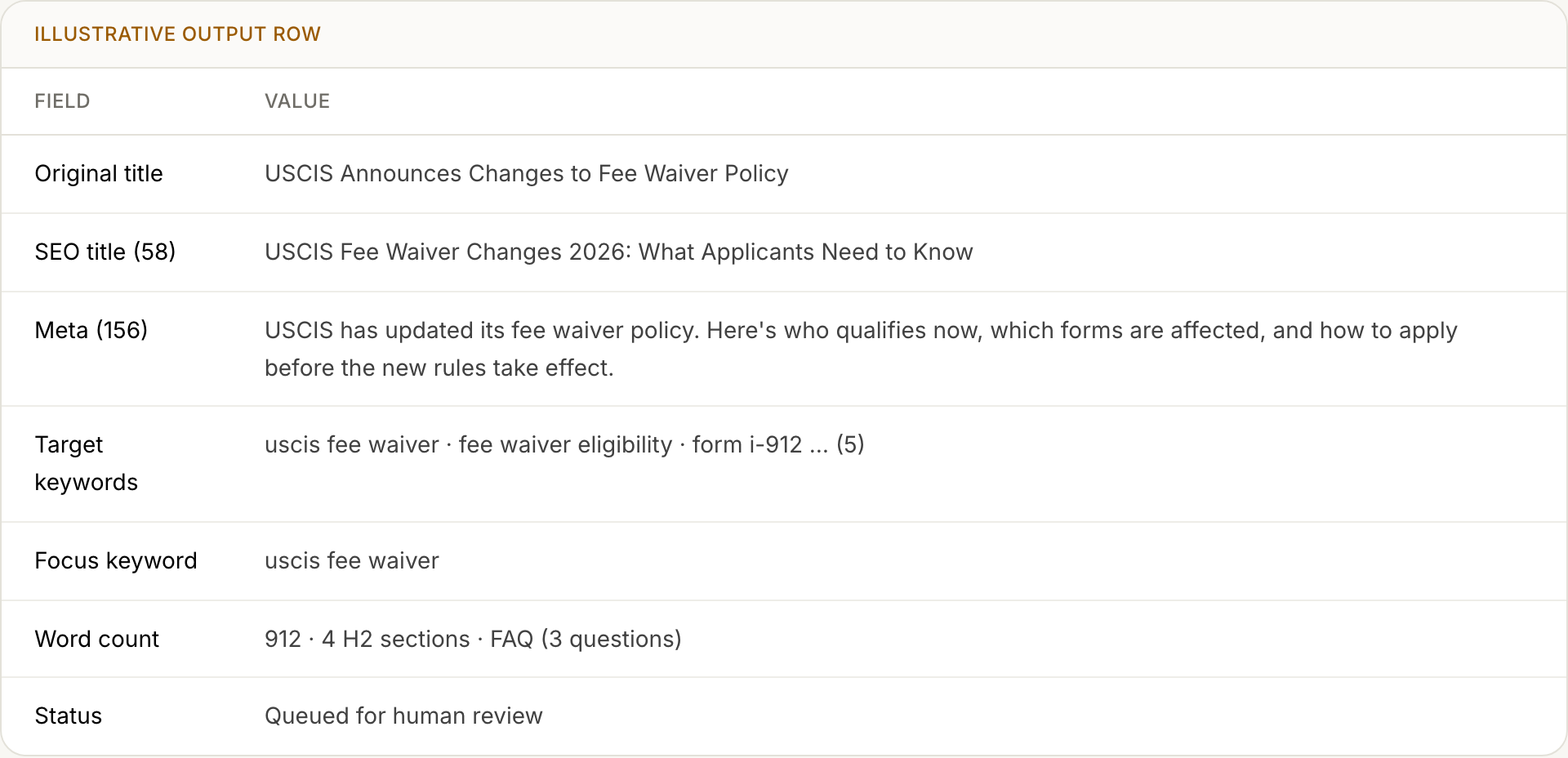
The pipeline runs privately, so here is an illustrative output row showing the shape of what lands in the sheet.
| Field | Value |
|---|---|
| Original title | USCIS Announces Changes to Fee Waiver Policy |
| SEO title (58) | USCIS Fee Waiver Changes 2026: What Applicants Need to Know |
| Meta (156) | USCIS has updated its fee waiver policy. Here's who qualifies now, which forms are affected, and how to apply before the new rules take effect. |
| Target keywords | uscis fee waiver · fee waiver eligibility · form i-912 … (5) |
| Focus keyword | uscis fee waiver |
| Word count | 912 · 4 H2 sections · FAQ (3 questions) |
| Status | Queued for human review |
Outcome
Time-sensitive news reaches the review queue the same day it breaks, with keywords, title and meta already to spec. People only have to edit and approve.
Its published-article sheet also became the data source for the Keyword Search Optimizer's stats view.