Case study
sponsored job finder.
Helps international students and workers find employers that may sponsor a visa. A daily feed drops postings that rule out sponsorship, checks each employer against E-Verify and visa-filing records, and sorts the rest by role.
- Role
- Solo: product, build & go-to-market
- Type
- Automation workflow
- Users
- International students (OPT / STEM OPT) and international workers
The spark
At my previous job, a marketing agency for universities, I watched students burn their OPT clock applying to jobs that were never going to sponsor them. The disqualifying sentence was usually right there in the description ("must be a U.S. citizen", "no sponsorship"), buried below the fold where nobody reads.
The problems to solve
- P1
OPT students burn their clock on jobs that won't sponsor
Every application to an employer that won't sponsor uses up days an OPT student can't get back, and the line that rules the job out is easy to miss.
- P2
Job boards don't filter by sponsorship, and the tools that do cost money
Job boards don't filter on sponsorship, and most tools that do charge a subscription. We wanted a free version for our own users as a perk. The budget was small and official job-data APIs were out of reach, so the filter had to be built from parts.
- P3
A board shared with students has to be trustworthy
The feed was shared with students as a job board, so it had to be trustworthy as well as fast. Being on E-Verify only means an employer has registered and says nothing about sponsorship, while dropping every employer with no record would hide some that do sponsor.
- P4
Good postings fill before students see them
Good postings fill fast, and recruiters review applicants from the top of the list when they open their system in the morning. A student who applies late lands under yesterday's hundreds of applications.
- P5
The rewards program needed a reason to join
The company wanted more students using its rewards program and needed a free feature worth signing up for. That only counts if clicks from the board can be traced back to it.
Every day at 6 a.m. US Eastern, the board refreshes with the last 24 hours of postings in the six most in-demand role categories. Each posting then goes through two checks. First, the employer is looked up in two lists built ahead of time: an E-Verify employer list and MyVisaJobs' H-1B and green-card filing history. Second, a text filter reads the description and drops postings that rule out sponsorship. If an employer has no record, it stays on the board, because no record only means it can't be verified.
How it works
- 01
Collect
Every day at 6 a.m. US Eastern, scheduled Apify runs scrape LinkedIn Jobs and Indeed for the last 24 hours of postings in the six most in-demand role categories. When a run finishes, its webhook kicks off the n8n workflow.
SolvesP2P4
- 02
Check the employer
Before the daily run, two lists are already in place: an E-Verify employer list (CSV) and H-1B and green-card filing history crawled from MyVisaJobs without an API. Each new posting's employer is looked up in both.
SolvesP3
- 03
Read the posting
A text filter drops any posting whose description contains a sponsorship dealbreaker: "U.S. citizen", "no sponsorship", "not sponsor", "not eligible for visa sponsorship" and similar phrases. For employers with no MyVisaJobs record, this is the check that does the work.
SolvesP1P2
- 04
Sort by role
Survivors are routed into six role tracks (software & IT, product, data, marketing, finance, sales & BD), each with its own sheet tab; seniority is normalized to Entry / Senior / Director.
SolvesP2
- 05
Clean & attribute
Apply links are stripped of tracking junk and tagged with campaign UTMs so clicks from the shared board are measurable. Missing salaries are filled in as "NA" so no cell is left blank.
SolvesP5
- 06
Publish
Each tab is cleared and rewritten every run, so the board is always today's list.
SolvesP2P4
Product decisions
6 a.m. Eastern, last 24 hours only
Good postings fill fast, and recruiters review applicants from the top of the list when they open their system in the morning. So the board is ready before the workday starts on the East Coast, and it only carries the last 24 hours. A student who applies first thing lands near the top of the pile instead of under yesterday's hundreds.
SolvesP4
A blocklist, not an allowlist
Very few postings say "we sponsor", but the ones that won't usually say so plainly. Filtering on dealbreaker phrases keeps the large middle that says nothing either way, which is where most real openings are. An allowlist would shrink the feed to almost nothing.
SolvesP1P3
E-Verify plus filing history
Checking started with E-Verify, but being on E-Verify only means an employer has registered. It says nothing about whether the company has ever hired or sponsored foreign workers. So I added MyVisaJobs' H-1B and green-card filing history, which answers the question students actually have: does this company sponsor people like me? Both lists are built before the daily run, so the morning job only has to look names up.
SolvesP3
Keep what can't be verified
No record doesn't mean a company won't sponsor. It only means we can't prove it either way, and sponsorship varies a lot from company to company. Dropping every unrecorded employer would make the list look cleaner, but it would also hide some that do sponsor. I chose more chances over a tidier list: postings that pass the text filter stay on the board, and each student decides whether to apply.
SolvesP3
Scrapers, not an API
The budget was small, official job-data APIs were out of reach, and the tools that filter by sponsorship charge users. So I built it from parts: pay-per-run Apify scrapers orchestrated in n8n. The catch is that scrapers can break when a site changes, so the workflow needs regular checking.
SolvesP2
A Google Sheet as the daily database
No database, no backend: one tab per role, cleared and rewritten every day. It cost nothing, the team could read and fix it without me, and students already live in spreadsheets. What I gave up: no job history across days, no de-duplication between runs, a row ceiling, and sponsor lists that have to be refreshed outside the daily run. That was acceptable for a daily list, and the first things to fix if it grew.
SolvesP2
Go-to-market
Two goals from day one: help students stop wasting their OPT clock, and give them a reason to join the company's rewards program, whose usage this feature was meant to lift.
Launch channels
- 1
Press release
Announced the launch to reach students, schools and partners beyond our own audience.
- 2
Blog
Explained why sponsorship filtering matters on OPT and how to use the board. The posts also rank in search.
- 3
On-site pop-up
Caught students already on the website and pointed them to the board.
- 4
Newsletter
Sent the board to existing subscribers, with the aim of making it something they check every day.
How success was measured
Daily active users
Is the board becoming a daily habit?
Rewards usage
Did rewards-program activity go up after launch?
Feature-driven sign-ups
How many people joined the rewards program because of this feature, which is how we'd know the board feeds it.
Built with
In production
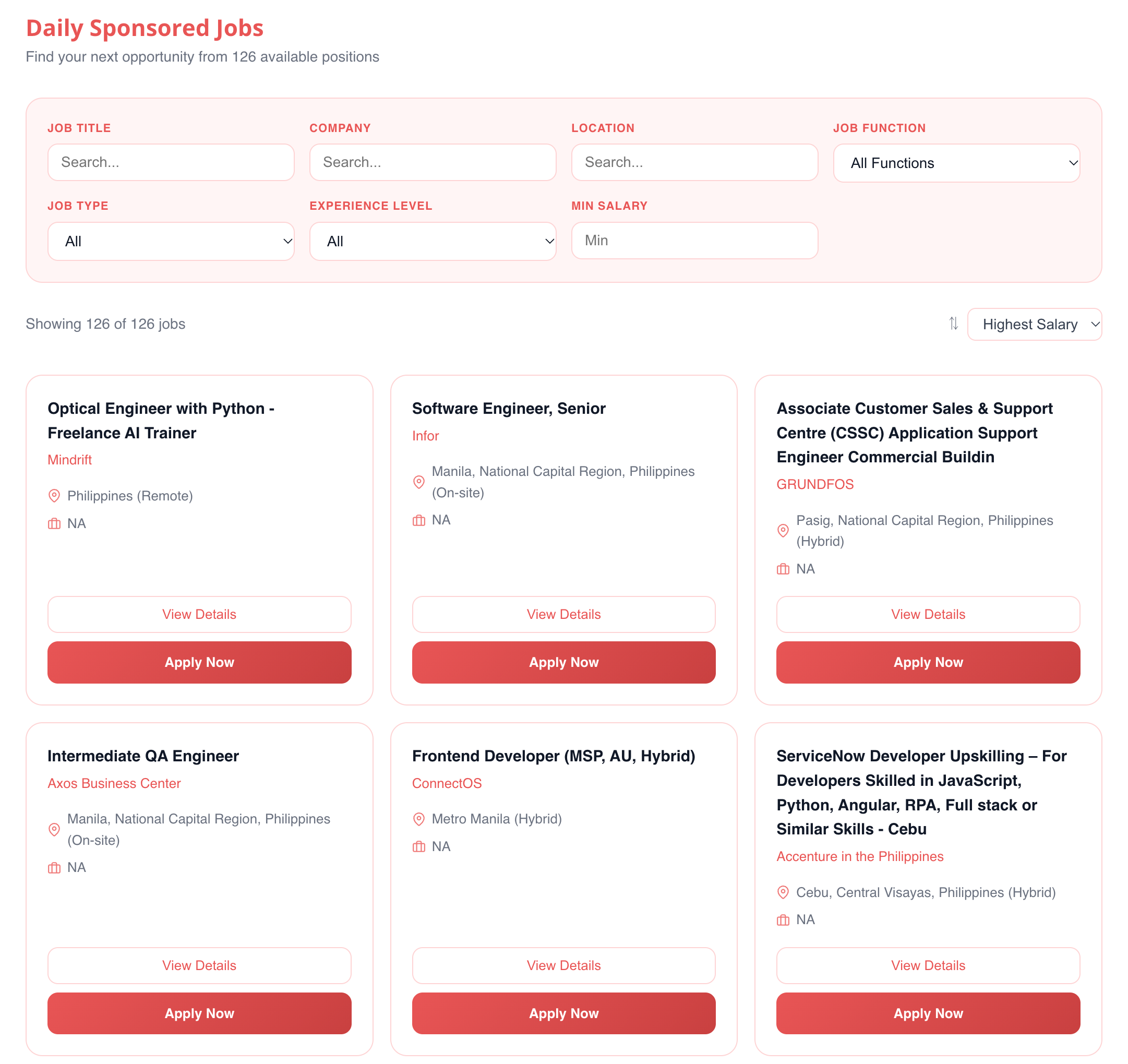
The live job board fed by the workflow. Referral details and marketing imagery cropped out.
Demo
The workflow runs privately in n8n, so here is a representative run: how the filter treats real-world posting language.
| Posting excerpt | Track | Verdict |
|---|---|---|
| "…must be a U.S. citizen due to contract requirements." | Software & IT | Dropped: citizenship |
| "We are unable to sponsor visas for this role." | Product | Dropped: no sponsorship |
| "Entry-level Data Analyst, SQL + Python, hybrid NYC." | Data | Kept → sponsorship check |
| "Growth Marketing Associate, international experience a plus." | Marketing | Kept → sponsorship check |
| "This role is not eligible for visa sponsorship." | Finance | Dropped: no sponsorship |
| "BD Manager, APAC partnerships, Mandarin preferred." | Sales & BD | Kept → sponsorship check |
Outcome
The feed went live as a public Daily Sponsored Jobs board on the company's website, with 126 open positions at the time of capture, filterable by title, company, location, function, job type, experience level and minimum salary. The dealbreaker postings never reach students, and every click out is attributable.
What's next
- Show each employer's check result on the board, so students can see at a glance who has a filing record and who can't be verified yet.
- Let students subscribe to a single role track by email.