Case study
tripprimer.
Helps English-speaking travellers make the call on a trip, with structured guides kept up to date. Korea comes first, and every guide is built to end in a decision.
- Role
- Solo: strategy, content & build
- Type
- Content product (SEO / AEO)
- Status
- Live: 55 guides
The spark
English-language travel content mostly answers "what is there". What travellers actually need is "which one, for me": which neighbourhood to stay in, which pass to buy, what to cut from a seven-day plan. tripprimer is built around that decision.
The problems to solve
- P1
Travel content lists options but doesn't help choose
A list of options leaves the decision (which area, which pass, what to cut) to the traveller.
- P2
Japan is crowded; Korea is open to well-structured pages
A census of English-language search results showed Japan has 10 to 150 times the supply of competing content, while Korea's results are mostly personal blogs that are beatable with under 200 well-structured pages. That set the order: Korea first, the US as the main audience and India as a secondary market.
- P3
Time-sensitive facts go stale and mistakes slip through
A travel guide is only useful while its time-sensitive data is current. Stale "verified on" dates, reused photos, unlicensed images and missing credits are easy to miss when someone has to remember to check.
- P4
Article count alone won't protect the site
What protects the site is its entity architecture, current data and full access for AI crawlers, so answer engines can cite it. Adding more articles matters less than making each page one an answer engine will quote.
What protects the site is its entity architecture, time-sensitive data that's kept current, and full access for AI crawlers so answer engines can cite it. Article count matters less.
How it works
- 01
Two axes, four shelves
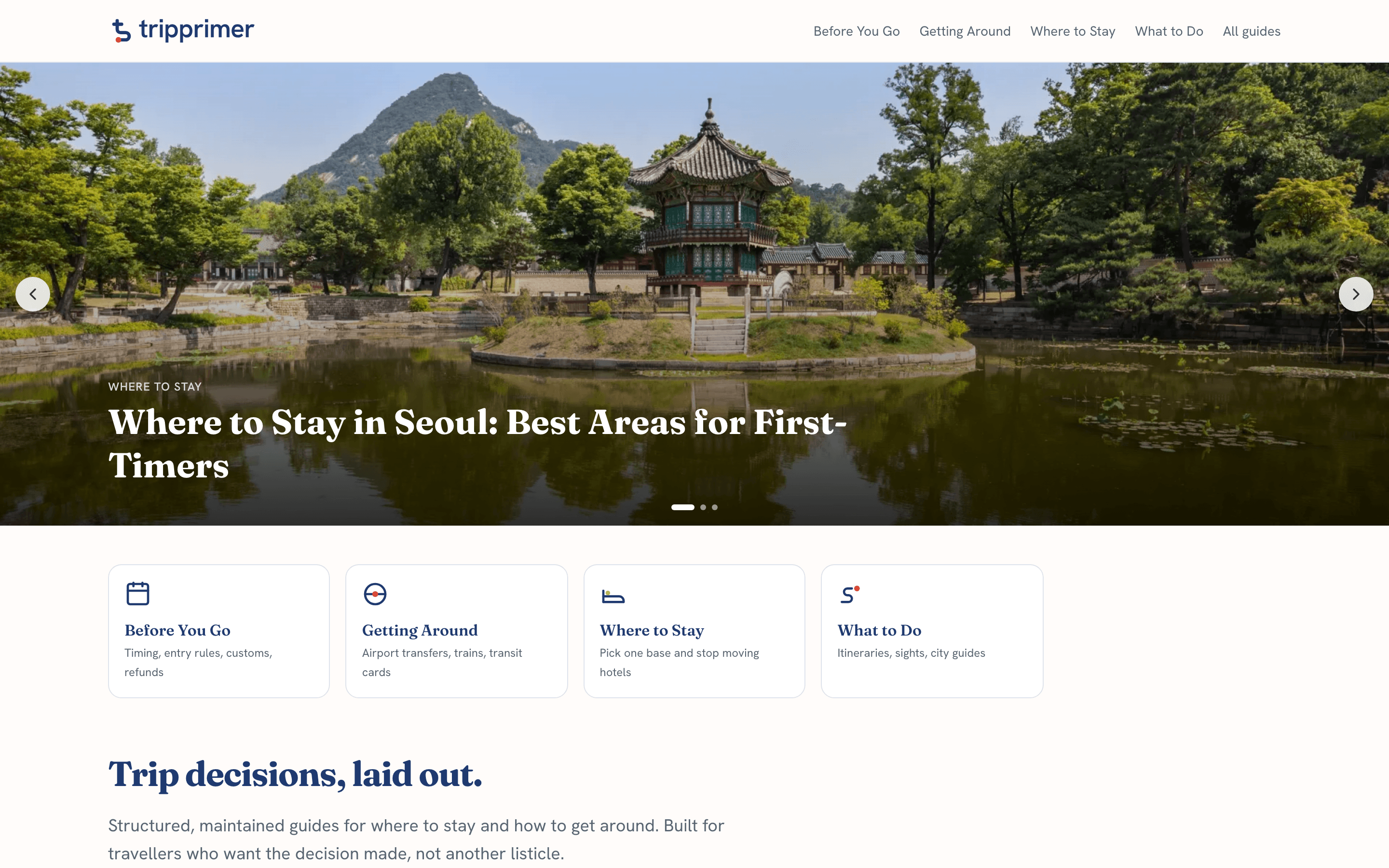
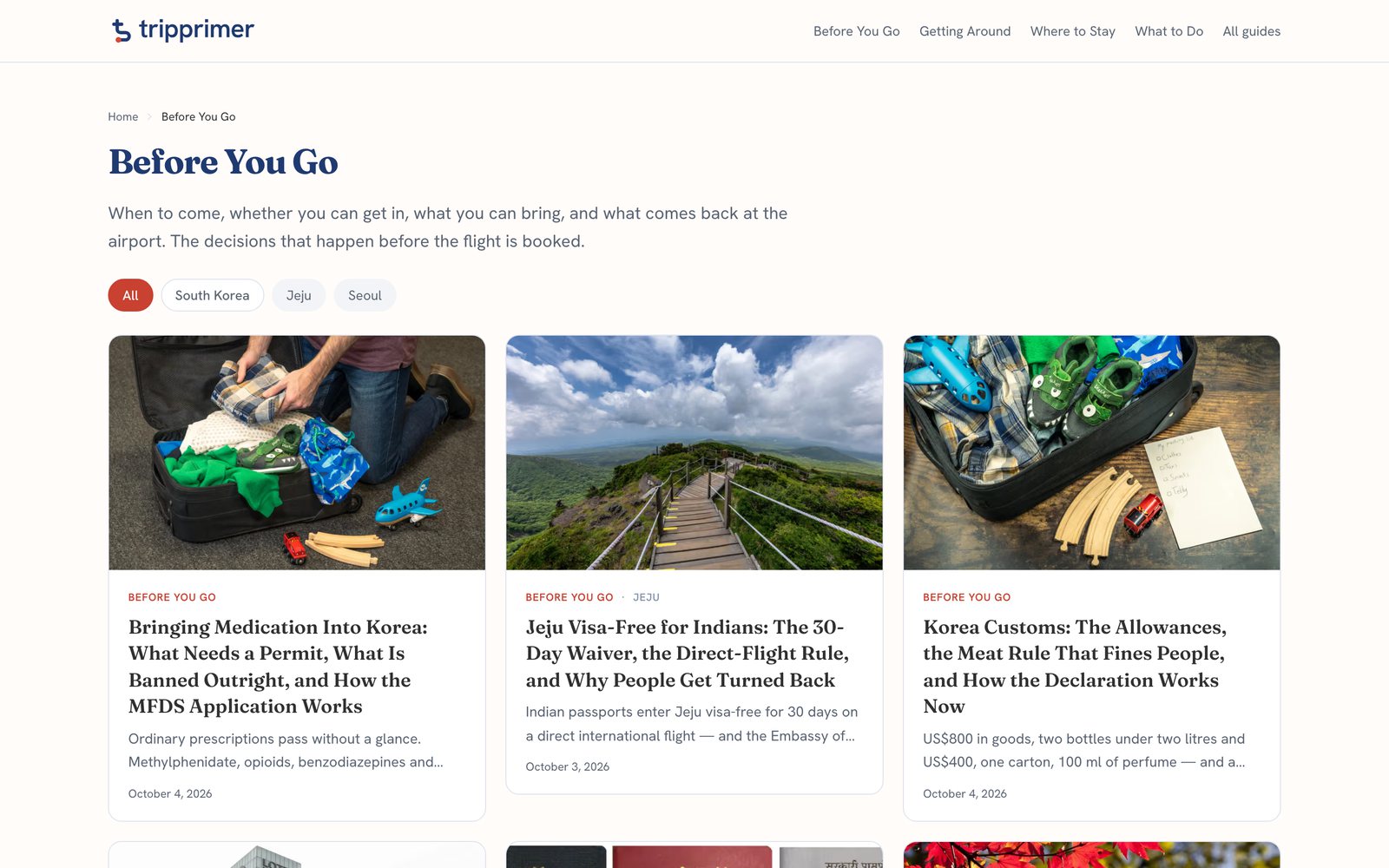
Every guide sits on a place axis (country → city) and a stage axis capped at four shelves: Before You Go, Getting Around, Where to Stay, What to Do. A city page pins its guide as "Start here" and groups the rest by shelf.
SolvesP1P2P4
- 02
Data-driven guides
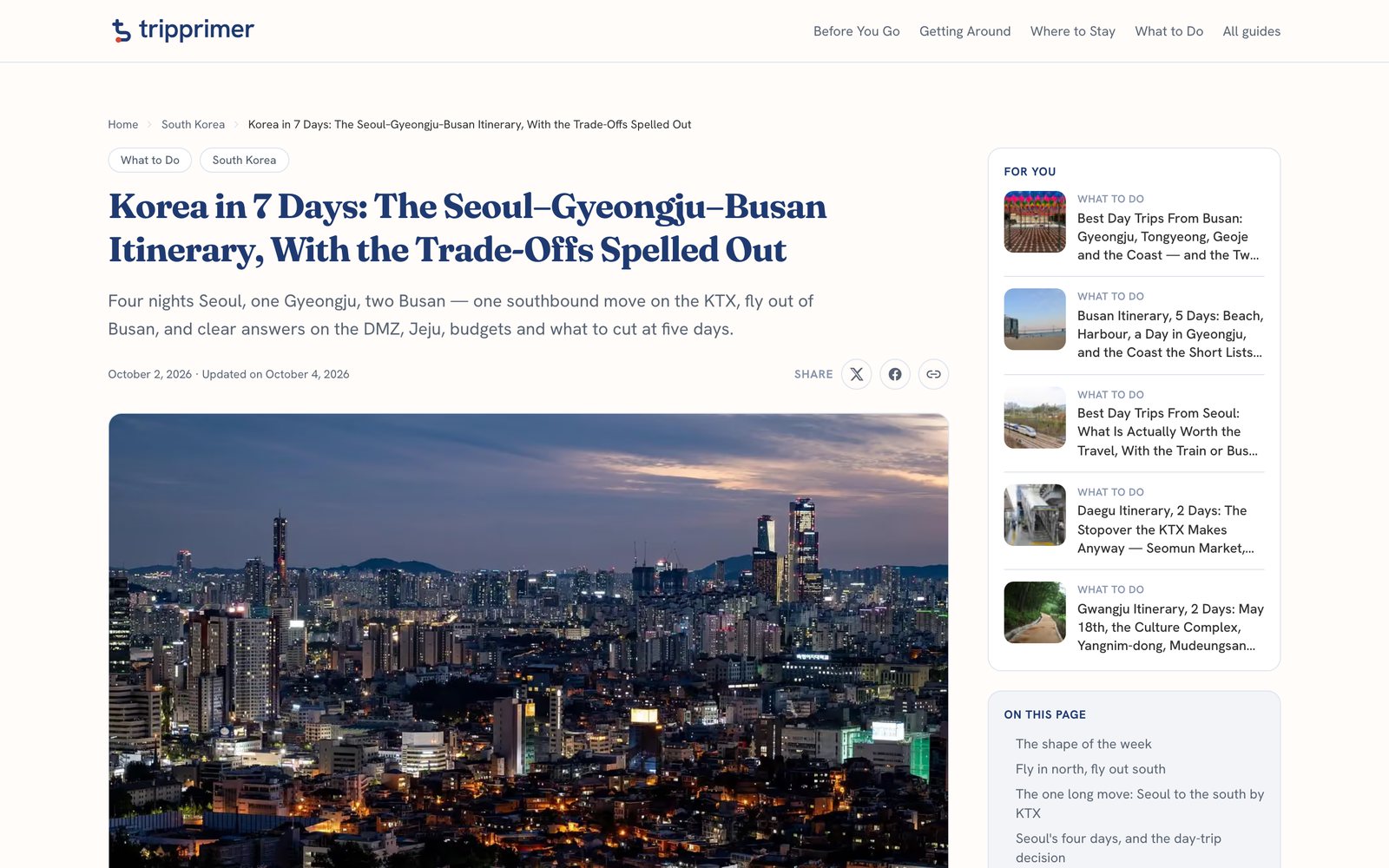
Itineraries, places and stays are structured datasets, rendered as day-by-day timelines with maps and comparison tables, so a fact is updated once, everywhere it appears.
SolvesP1P3
- 03
Notion to site, every six hours
Editing happens in Notion. A scheduled GitHub Action syncs it into the repo, validates every row against schemas, commits, deploys and pings IndexNow. A failed check publishes nothing.
SolvesP3
- 04
An 11-check quality gate
The build refuses to ship on schema errors, stale "verified on" dates, reused photos, unlicensed images or missing credits, so nobody has to remember to check.
SolvesP3
Product decisions
Korea over Japan
Japan has the bigger audience, but the competition there is professional publishers, while Korea's is personal blogs. I'd rather take a market I can win than a bigger one I can't rank in.
SolvesP2
Cap the shelves, let tags grow
The navigation is frozen at four shelves; a new kind of article becomes a tag instead of a new section. A tag only gets its own page when Search Console data shows demand.
SolvesP2P4
Volume to 100, with checkpoints
New articles restarted in October 2026 with a first goal of 100. Every 10 articles, the batch is checked against US search demand, and at 100 the share of pages indexed decides how fast the next wave goes. Each article follows the answer-engine format and keeps tripprimer's own verdict, so more pages doesn't mean pages no one cites.
SolvesP4
Notion for workflow, git for content
Notion is a great editor but a fragile production database (rate limits, build-time fetches). Content lands in git as files, so the site builds fast and never depends on Notion being up.
SolvesP3
Page motion that leaves SEO alone
The site depends on search and answer engines, so motion was only allowed if the crawled page stayed the same. Tapping a shelf entry or an article card opens the next page with a circle reveal from the tap point, built on React's ViewTransition with no new packages, and back and forward stay instant. On an itinerary, the nearest stop activates once scrolling settles and the rail draws to it segment by segment. The server-rendered HTML is unchanged. Measured LCP is about 0.3 s on the home page and 0.44 s on an itinerary, with a CLS of 0.
SolvesP4
Built with
Live site
Real pages from the live site: a destination hub, a dataset-driven itinerary and one of the four shelves.
tripprimer.com/en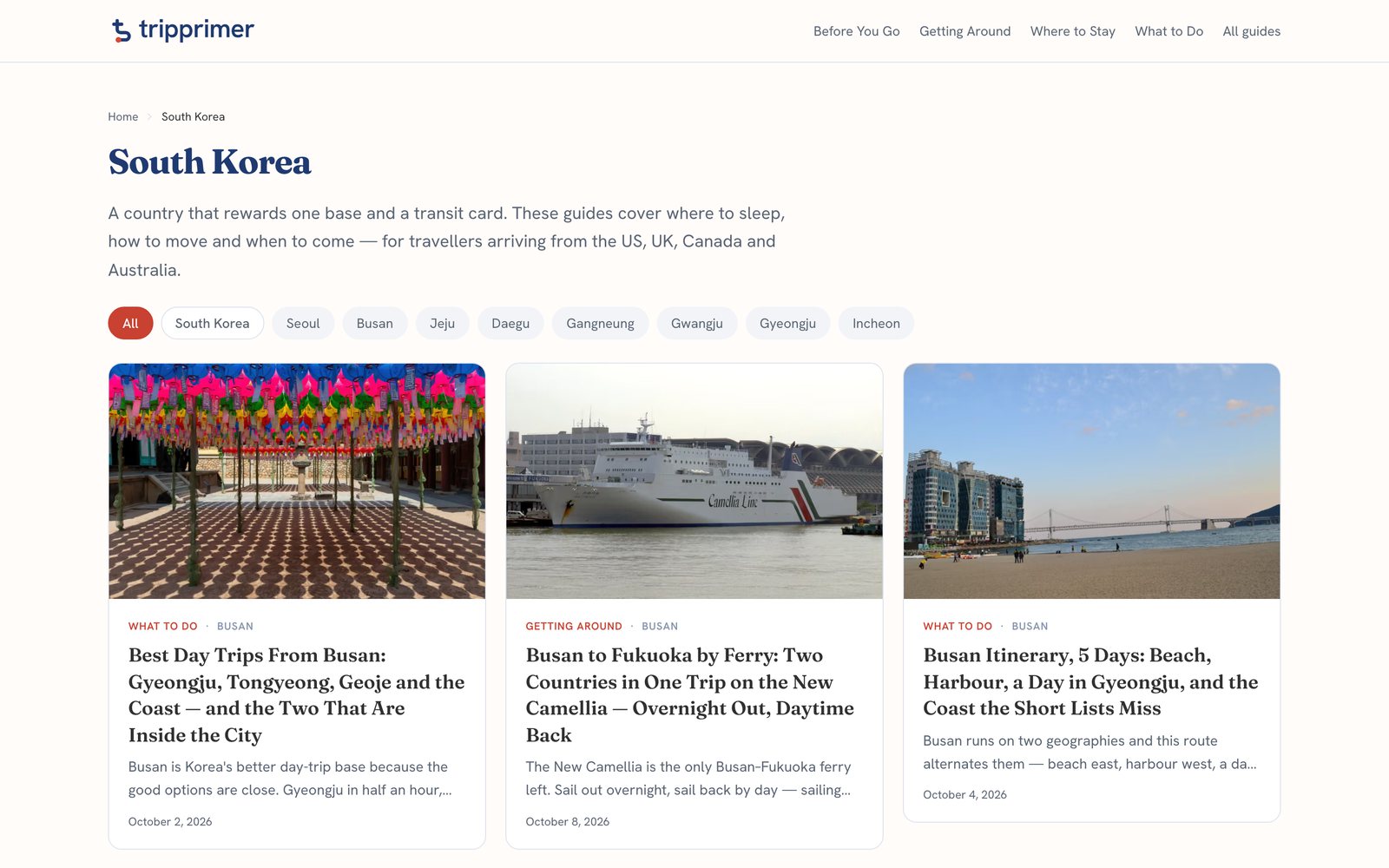
Outcome
Live at tripprimer.com with 55 guides: 46 for South Korea (Seoul, Busan, Jeju and beyond) and 9 for car-free travel in six US cities, published through a pipeline that runs itself every six hours.
It is also Standfirst's first site: the ads lane is modeled on its campaigns, and its service page feeds Standfirst's waitlist.
Bing AI citations went from 12 to 22 in the 30 days to 2 November 2026 (Bing Webmaster AI performance). The "Is New Orleans safe" page was newly cited 5 times.
What's next
- Promote tags to pages only where Search Console shows demand.
- Finish the answer-engine rewrite of the Korea guides.